

Structured Cabling Services in Dallas–Fort Worth: What to Expect

A reliable network starts with the infrastructure behind it. Structured cabling services Dallas businesses rely on provide an organized, scalable system for connecting computers, phones, wireless access points, security systems, servers, and other network equipment.
Instead of using disconnected cables added over time, structured cabling creates a planned infrastructure using standardized copper and fiber optic cabling, patch panels, racks, outlets, and cable-management systems.
At Excellent IT Telecom Solutions (EITS), we provide structured cabling solutions for businesses throughout Dallas–Fort Worth, including Irving, Dallas, Fort Worth, Plano, Frisco, Arlington, and surrounding DFW communities.
Whether you are building a new office, expanding a warehouse, upgrading a data center, or replacing outdated network cabling, a properly designed cabling system can make your network easier to manage and prepare your facility for future technology requirements.
What Are Structured Cabling Services dallas?
Structured cabling is the physical infrastructure that connects different parts of your IT and communications network.
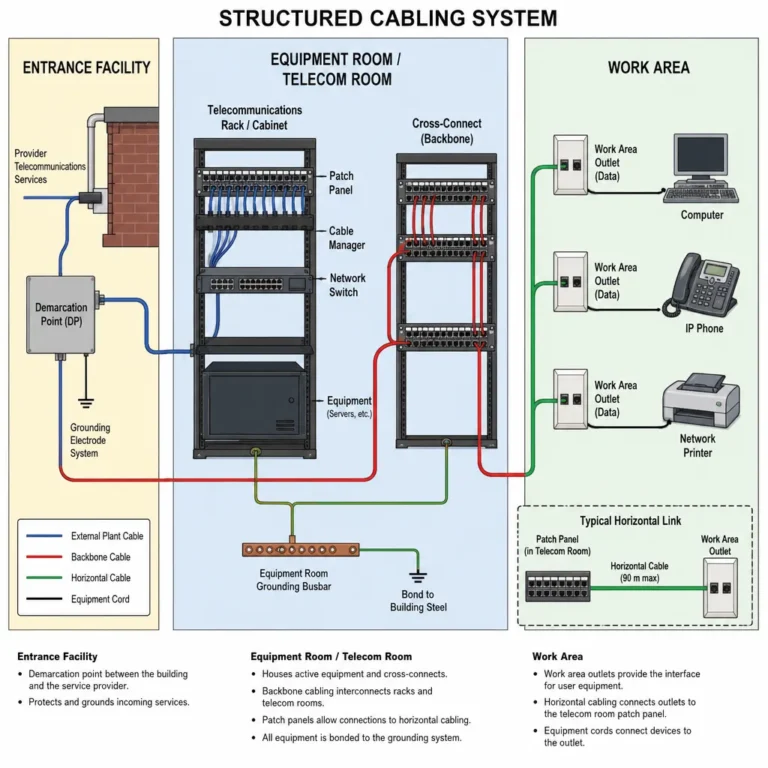
A professional structured cabling Dallas TX installation may include copper Ethernet cabling, fiber optic backbone connections, patch panels, equipment racks, telecommunications rooms, work-area outlets, and cable pathways.
The goal is to create an organized network infrastructure rather than installing individual cables whenever a new device is added.
A structured approach also makes troubleshooting, expansion, moves, and future upgrades easier because network connections are clearly organized and documented.
What Does a Structured Cabling Installation Include?
Every facility has different network requirements, but a complete structured cabling project can include:
-
Cat6 and Cat6A cabling for workstations, phones, access points, cameras, and network equipment
-
Fiber optic backbone cabling for high-bandwidth and longer-distance network connections
-
Horizontal cabling between telecommunications rooms and work areas
-
Backbone cabling connecting network rooms, floors, or buildings
-
Patch panel installation for organized cable termination
-
Network and equipment racks for switches, patch panels, and related hardware
-
Cable management to keep network infrastructure clean and accessible
-
Work-area outlets and wall plates
-
Cable labeling and documentation
-
Testing and certification to verify installed network links
A well-designed installation gives businesses a structured foundation that can support current network equipment while simplifying future changes.
Why Businesses Need Professional Structured Cabling
Network performance depends on more than switches, routers, and internet bandwidth. The cabling connecting those systems also plays an important role.
Poor cable routing, damaged terminations, excessive cable lengths, incorrect components, or an unorganized telecommunications room can create unnecessary network problems.
Professional structured cabling helps businesses create a cleaner and more manageable physical network.
It can also make it easier to add:
-
New employees and workstations
-
Wireless access points
-
VoIP phone systems
-
IP security cameras
-
Access control systems
-
Additional network switches
-
Servers and storage systems
-
Higher-speed network connections
For growing businesses, this scalability can be especially valuable because the cabling infrastructure does not need to be redesigned every time network requirements change.
Structured Cabling for Dallas–Fort Worth Businesses
DFW includes everything from corporate offices and data centers to warehouses, healthcare facilities, retail locations, and large commercial properties.
Each type of facility can require a different cabling design.
An office may need high-density Cat6A connections for computers, VoIP phones, and Wi-Fi access points, while a warehouse may require longer cable pathways, fiber backbone connections, surveillance connectivity, and strategically located network cabinets.
Data centers can require even more structured cable management because numerous copper and fiber connections must remain organized, accessible, and easy to identify.
EITS designs structured cabling systems around the actual requirements of the facility rather than applying the same layout to every project.
Structured Cabling Standards and Best Practices
Professional network cabling should follow recognized industry standards.
EITS structured cabling projects are designed around applicable ANSI/TIA telecommunications cabling standards, including standards covering balanced twisted-pair copper and optical fiber infrastructure.
Current standards include ANSI/TIA-568.2-E for balanced twisted-pair telecommunications cabling and components and ANSI/TIA-568.3-E for optical fiber cabling components.
Following recognized cabling practices helps create consistent installation, termination, labeling, testing, and network-management processes.
It is especially important when businesses are planning infrastructure for technologies such as Gigabit Ethernet, 10 Gigabit Ethernet, high-speed fiber backbones, wireless networks, and data center connectivity.
Copper vs. Fiber Structured Cabling
Copper and fiber serve different purposes within modern network infrastructure.
Cat6 and Cat6A copper cabling are commonly used for connections between network switches and devices such as computers, phones, cameras, and wireless access points.
Fiber optic cabling is often preferred for backbone connections, longer-distance links, high-bandwidth environments, and connections between network rooms or buildings.
Many commercial networks use both technologies.
For example, fiber may connect the main equipment room to telecommunications rooms throughout a building, while Cat6A cabling connects those network rooms to individual devices.
The right combination depends on distance, bandwidth requirements, equipment, building design, and plans for future expansion.
Why Choose a Local DFW Structured Cabling Contractor?
Searching for structured cabling near me usually means you need more than cable installation. You need a contractor who can understand the building, inspect existing infrastructure, plan cable pathways, identify network requirements, and support future expansion.
Working with a Dallas–Fort Worth structured cabling team can also make site surveys, project coordination, service calls, and future network changes easier.
EITS supports structured cabling projects throughout the DFW metroplex from Irving, Texas.
Our services can support new installations as well as existing infrastructure that requires expansion, cleanup, replacement, or moves, adds, and changes (MACs).
Structured Cabling for Offices, Warehouses and Data Centers
Our structured cabling solutions can support a wide range of commercial environments, including:
-
Corporate offices
-
Warehouses and distribution centers
-
Data centers
-
Healthcare facilities
-
Commercial buildings
-
Retail locations
-
Multi-tenant properties
-
Telecom rooms
-
Server rooms
-
Enterprise network environments
The objective is the same for every project: build a clean, organized, reliable cabling infrastructure that supports the network today while providing room for future growth.
Get a Structured Cabling Quote in Dallas–Fort Worth
If you are looking for structured cabling services Dallas businesses can depend on, Excellent IT Telecom Solutions can help you plan and deploy the physical infrastructure behind your network.
From Cat6 and Cat6A cabling to fiber optic backbones, patch panels, network racks, cable management, testing, and infrastructure upgrades, our team provides structured cabling solutions throughout the Dallas–Fort Worth metroplex.
Serving Dallas, Irving, Fort Worth, Plano, Frisco, Arlington, and surrounding DFW areas.
Request a structured cabling site assessment and quote today.