
Single Mode vs Multimode Fiber: Which One Do You Need?
Choosing between single mode vs multimode fiber is one of the most important decisions in a fiber network project. Both are high-performance fiber optic cables, both move data using light, and both can support fast, reliable connectivity. But they are designed for different distances, budgets, equipment types, and network environments.
The short answer is simple: choose single mode fiber for longer distances, higher scalability, and carrier-style networks. Choose multimode fiber for shorter indoor runs where lower transceiver cost and easy deployment matter most.
The right choice depends on how far the signal needs to travel, what bandwidth you need now, how much room you want for future upgrades, and whether your project is inside a building, between buildings, across a campus, or part of a larger service provider network.
Quick Decision Guide
If you need a fast recommendation, start here:
Choose single mode fiber if:
- Your fiber run is long, especially between buildings, across a campus, or to a telecom handoff.
- You want the most future-ready cabling option.
- You may need 10G, 40G, 100G, 400G, or higher speeds over longer distances.
- You are connecting data centers, carriers, backbone infrastructure, or outdoor fiber routes.
- You are willing to spend more on optics to gain distance and scalability.
Choose multimode fiber if:
- Your cable runs are short, usually within the same building or data room.
- You are connecting switches, servers, storage, patch panels, or equipment racks.
- You want lower-cost short-range transceivers.
- Your network is primarily enterprise LAN, campus building, AV, or data center interconnect over limited distances.
- You need a practical solution for high-speed links without paying for long-reach optics.
In most modern projects: single mode fiber is the better long-term choice for distance, backbone, and growth. Multimode fiber is still a strong choice for short indoor connections where equipment cost matters.
What Is Single Mode Fiber?
Single mode fiber is a type of optical fiber designed to carry one primary path, or mode, of light through a very small glass core. The core is typically much smaller than the core in multimode fiber, which helps the light travel farther with less signal distortion.
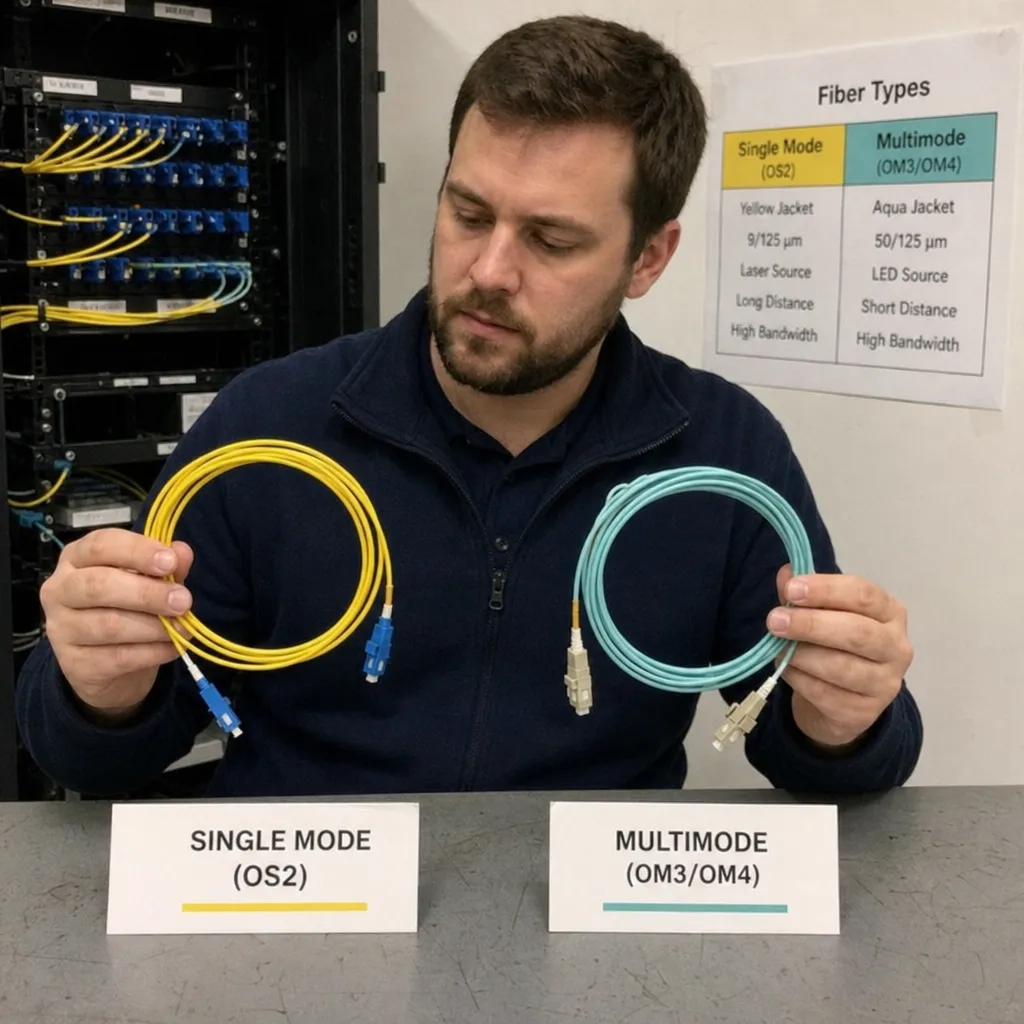
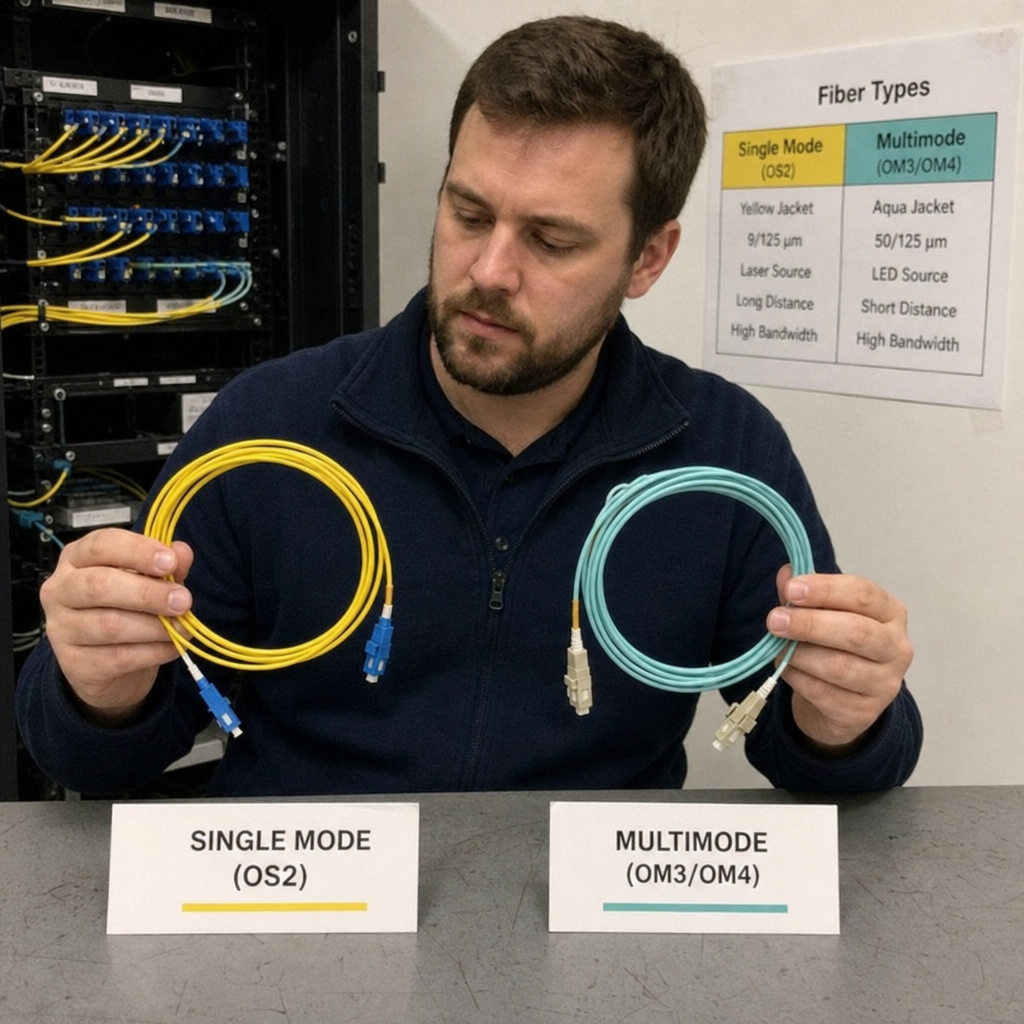
Because the light travels in a more direct path, single mode fiber supports longer distances and higher bandwidth potential. It is commonly used in telecom networks, internet service provider infrastructure, metropolitan networks, long campus links, data center interconnects, and high-capacity enterprise backbones. Single mode cables are often associated with yellow jackets, though jacket color can vary by manufacturer or project specification.
Common single mode fiber use cases:
- Building-to-building fiber connections
- Campus backbone networks
- Long-distance telecom links
- Internet service provider handoffs
- Data center interconnects
- Passive optical networks
- High-speed enterprise backbone links
- Security, utility, transportation, and municipal fiber networks
- Future-ready structured cabling systems
Single mode fiber stands out because it can support very long distances and high bandwidth with the right optics. It also offers a strong upgrade path because the installed cable can often support faster speeds later by replacing transceivers and network equipment.
If you are looking for single mode patch cables for your project, our LC/UPC to LC/UPC OS2 Duplex Fiber Patch Cable ships from Irving, Texas and is built for OS2 single mode deployments.
What Is Multimode Fiber?
Multimode fiber is an optical fiber cable designed to carry multiple paths, or modes, of light through a larger core. That larger core makes it easier for lower-cost light sources to launch signals into the cable, which is one reason multimode systems are often economical for short-distance networking.
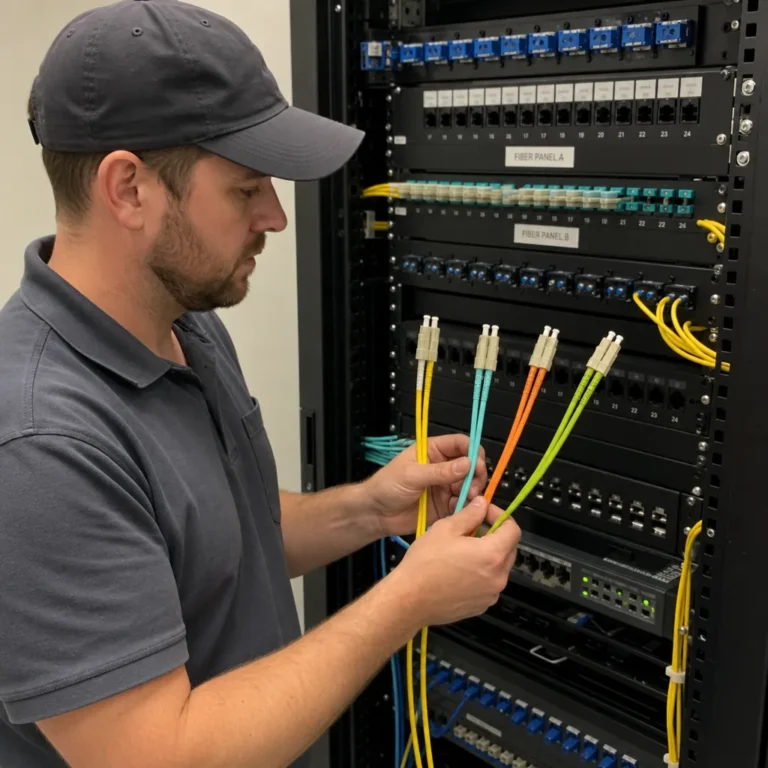
Multimode fiber is commonly used inside buildings, equipment rooms, data centers, and enterprise LAN environments. It performs well for short runs between switches, servers, storage devices, patch panels, and network closets. Multimode fiber jackets are often orange, aqua, violet, or lime green, depending on the fiber category. Common multimode categories include OM1, OM2, OM3, OM4, and OM5, with OM3 and OM4 being the most widely used in high-speed installations today.
Common multimode fiber use cases:
- Short data center links
- Server-to-switch connections
- Storage area networks
- Enterprise LAN backbones inside a building
- Horizontal or riser cabling in commercial facilities
- Network closet uplinks
- High-speed connections between nearby equipment racks
Multimode fiber is attractive because it can offer strong performance over short distances while often using lower-cost optics. For many indoor connections, it provides the speed needed without the cost of long-reach single mode transceivers.
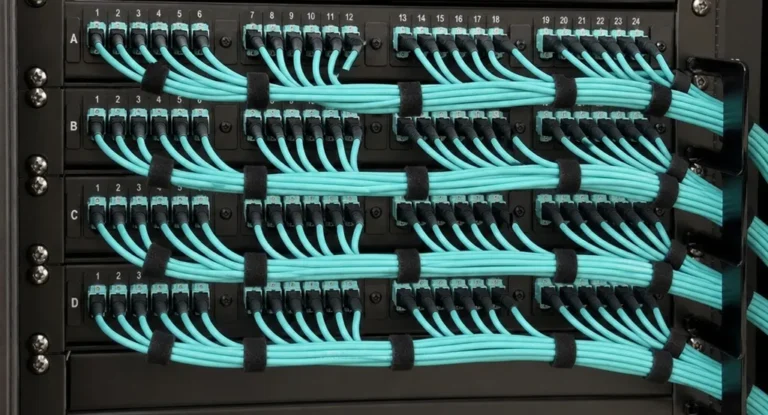
Our MPO Female to MPO Female OM4 Fiber Optic Patch Cable is available in Aqua (standard OM4 for 40G/100G) and Magenta (400G-ready) and ships directly from Irving, Texas.
Single Mode vs Multimode Fiber: The Core Difference
The main difference between single mode and multimode fiber is the way light travels through the cable.
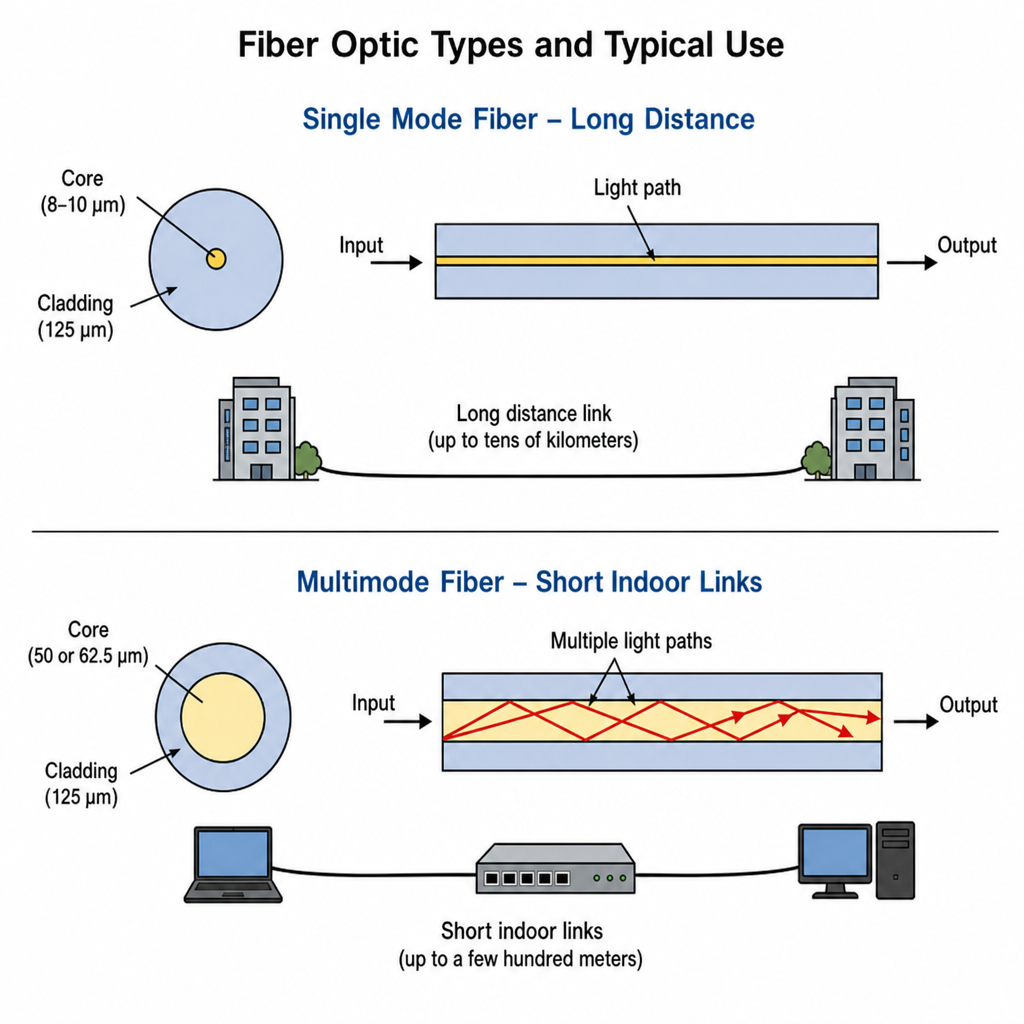
Single mode fiber has a small core (8-10 microns) that allows light to travel in one main path. This reduces modal dispersion, which means the signal can stay cleaner over longer distances. Multimode fiber has a larger core (50 or 62.5 microns) that allows multiple light paths. This works well for shorter distances, but those multiple paths can spread out over distance, limiting how far the signal can travel at high speeds.
Think of it this way: single mode is like a narrow, direct highway for one focused beam of light. Multimode is like a wider road where light can take multiple paths, which is useful over short trips but less efficient over long ones. This design difference affects everything else: distance, bandwidth, cost, optics, installation planning, and future scalability.
Summary at a Glance
Single mode fiber
- Best for long distances and high-capacity backbones
- Common in telecom, carrier, campus, and data center interconnect environments
- Smaller core size (8-10 microns)
- Typically uses laser-based optics
- Often higher transceiver cost
- Excellent future scalability
- Strong choice for outdoor, between-building, and long-reach links
Multimode fiber
- Best for short indoor connections
- Common in enterprise LANs, server rooms, and data centers
- Larger core size (50 or 62.5 microns)
- Often uses lower-cost short-range optics
- Distance is more limited at higher speeds
- Practical and cost-effective for rack-to-rack or room-to-room links
- Strong choice when runs are short and budget is equipment-sensitive
Distance Comparison
Distance is usually the first factor in the single mode vs multimode fiber decision. Single mode fiber is built for long-distance performance. Depending on the optics and network design, it can support links measured in kilometers and, in specialized networks, much farther. For most commercial and enterprise planning, single mode is the default choice when a run goes between buildings, across large sites, or beyond typical multimode reach.
Multimode fiber is designed for shorter distances. It performs very well within a building, in a data center, or between nearby telecom rooms, but its reach decreases as data rates increase. The exact distance depends on the fiber category, connector quality, transceiver type, and speed.
Practical distance guidance:
Use single mode fiber when the run is between buildings, the distance may exceed a few hundred meters, you are planning a campus backbone, or you need maximum flexibility for future speed upgrades. Use multimode fiber when the run is short and inside the same facility, you are connecting equipment within a data room, or lower-cost short-reach optics are a priority.
If you are unsure about distance, single mode is often the safer long-term cabling choice.
Bandwidth and Speed Comparison
Both single mode and multimode fiber can support high-speed networking. The difference is how far they can support those speeds and how well they scale over time.
Single mode fiber generally offers the highest bandwidth potential over the longest distances. It is commonly selected when networks need room to grow from 1G to 10G, 25G, 40G, 100G, and beyond. The cable itself is not usually the limiting factor. Instead, performance depends heavily on optics, equipment, link design, and loss budget.
Multimode fiber can also support high speeds over short distances. OM3 and OM4 multimode fiber are widely used for 10G and higher-speed connections in data centers and enterprise environments. However, as speeds increase, supported distances typically become shorter.
If your network is short-range and you know your speed requirements, multimode may be completely sufficient. But if you are installing new backbone cabling and want the broadest upgrade path, single mode fiber is usually the more scalable choice.
Cost Comparison
Cost is where the decision becomes more nuanced. Many people assume multimode fiber is always cheaper, but that is not always true when you look at the full system.
The cable cost difference between single mode and multimode has narrowed over time. In many projects, the cable itself may not be the biggest cost driver. Labor, pathway, conduit, termination, testing, design, and hardware can matter more. The larger cost difference is often in the optics. Multimode transceivers are commonly less expensive for short-reach connections, which makes multimode attractive in environments with many short fiber links.
Single mode optics have historically cost more, especially for longer reaches. However, pricing varies widely depending on speed, reach, brand, compatibility, and supply conditions. For some modern speeds and deployment types, the total cost difference may be smaller than expected.
Cost decision guidance: choose multimode fiber when you have many short links and want to reduce short-range transceiver costs. Choose single mode fiber when cable replacement would be expensive later, distance may grow, or future bandwidth needs are uncertain. In many real-world projects, the most expensive fiber is not the cable you buy now. It is the cable you have to replace later because the original design could not support the next requirement.
Installation and Compatibility
Both single mode and multimode fiber require proper handling, clean connectors, correct bend radius, and accurate testing. The most important compatibility rule is simple: single mode and multimode components should not be mixed within the same optical link. The fiber type, patch cords, connectors, transceivers, and equipment ports must all be matched correctly.
Check these details before ordering:
- Required speed now and in the future
- Total link distance
- Fiber type already installed, if any
- Connector type, such as LC, SC, ST, or MPO
- Transceiver standard and reach
- Switch, router, server, or storage compatibility
- Indoor or outdoor pathway requirements
- Fire rating requirements such as plenum or riser
- Fiber count and spare strand requirements
- Testing requirements for acceptance and documentation
Use Cases: Which Fiber Fits Each Environment?
Office buildings: Multimode fiber is often used for short indoor backbone links between telecom rooms and network closets. Single mode is a strong option for larger office facilities or new construction where long-term flexibility matters. Best fit: multimode for short indoor links, single mode for backbone growth and future readiness.
Data centers: Data centers can use both fiber types. Multimode fiber is common for short connections between racks, switches, and servers. Single mode fiber is common for data center interconnects, long rows, high-speed aggregation, and connections to carriers or cloud infrastructure. Best fit: multimode for short internal links, single mode for interconnects and scalable high-speed architecture.
Campus networks: Campus networks often include multiple buildings, outdoor pathways, long routes, and a need for long-term expansion. Single mode fiber is usually the safer and more scalable choice for campus backbone. Best fit: single mode for campus backbone and between-building connections.
Industrial facilities: Industrial environments may involve long distances, electrical noise, and harsh pathways. For long plant runs, single mode is generally preferred. For short machine or control room connections, multimode may still work well.
Small businesses: If the project involves a few short runs inside one office, multimode can be cost-effective. However, if the business owns the building or expects growth, single mode may be worth considering even if current requirements are modest.
Pros and Cons of Single Mode Fiber
Advantages:
- Supports much longer distances than multimode
- Offers excellent future scalability
- Works well for high-speed backbone and carrier networks
- Reduces distance-related limitations in many designs
- Often preferred for new long-term infrastructure
- Strong fit for outdoor and between-building applications
Disadvantages:
- Optics may cost more, especially for long-reach applications
- Requires careful planning around transceiver compatibility
- May be more than needed for very short equipment-room links
Pros and Cons of Multimode Fiber
Advantages:
- Practical for short-distance high-speed links
- Often uses lower-cost short-reach optics
- Common in enterprise LAN and data center environments
- Works well for rack-to-rack and room-to-room connections
- Cost-effective when many short links are needed
Disadvantages:
- Shorter maximum distance than single mode
- Distance limits become more important at higher speeds
- Older multimode types may restrict future upgrades
- Less ideal for campus, outdoor, or long building-to-building runs
Common Mistakes to Avoid
Choosing based only on cable price: Cable price is only one part of total project cost. Optics, labor, pathways, terminations, testing, and future upgrades can have a bigger financial impact.
Ignoring distance at future speeds: A multimode link that works for today’s speed may not support tomorrow’s speed over the same distance. Always check both current and future bandwidth needs.
Mixing single mode and multimode parts: A single mode transceiver should be used with single mode fiber. A multimode transceiver should be used with multimode fiber. Do not mix cable types, patch cords, and optics casually.
Forgetting about building codes and cable ratings: US installations may require the correct cable jacket rating for the environment, such as plenum or riser. Outdoor, underground, and industrial pathways may also require specific cable construction.
Underestimating the value of spare strands: Adding spare fiber during the initial installation is usually easier than pulling new cable later. Plan for growth, redundancy, and future services.
Buyer’s Checklist
Before you finalize your decision, answer these questions:
- How far does the link need to run?
- Is the cable staying inside one building or going between buildings?
- What speed do you need today? What speed might you need in three to five years?
- How many fiber links are required?
- What optics does your network equipment support?
- Are you matching existing single mode or multimode infrastructure?
- What connector type is required?
- Does the pathway require plenum, riser, outdoor, armored, or direct-burial cable?
- Would replacing the cable later be difficult or expensive?
If several answers point to long distance, future upgrades, or hard-to-replace pathways, single mode fiber is usually the stronger option. If the answers point to short, predictable indoor runs with cost-sensitive optics, multimode may be the better fit.
Final Recommendation
When comparing single mode vs multimode fiber, the best choice depends on the application, not just the cable type.
For long-distance, high-bandwidth, future-ready networks, choose single mode fiber. It is the preferred option for campus backbones, building-to-building connections, carrier links, data center interconnects, and infrastructure that needs room to grow.
For short-distance indoor networks, choose multimode fiber when it meets your speed and distance requirements and helps control transceiver costs. It remains a practical choice for enterprise LANs, equipment rooms, and many data center links.
If you are still unsure, use this rule of thumb: multimode is usually a good fit for short, known, indoor links. Single mode is usually the better fit for long, scalable, or hard-to-replace infrastructure.
Shop Fiber Optic Cables at EITS
Excellent IT Telecom Solutions LLC ships fiber optic cables from Irving, Texas. We carry both OS2 single mode and OM4 multimode options built for modern network environments.
Shop LC/UPC OS2 Single Mode Cable
Shop MPO OM4 Multimode Cable